
The order book model
Every market on Worm has two sides: Yes and No. Each share is priced between 0 and 1 USDC, and the Yes price reflects the market’s estimated probability that the event occurs. When you place a trade, you’re buying shares from another trader who’s willing to sell at that price, or selling to one who’s willing to buy. The current price is simply where buyers and sellers have most recently agreed.Order types differ by market type. User-created markets support both market orders and limit orders. You can set a specific price you’re willing to buy or sell at. Leveraged markets currently support market orders only. Limit orders for leveraged markets are in development.
Market formats
Worm supports two market formats: Binary markets are the standard format: a single event either happens or it doesn’t. You trade Yes or No. Categorical markets have multiple named outcomes. Each outcome has its own Yes/No price and is traded independently. Sports matches (Team A / Draw / Team B) and multi-outcome questions (“Which of these will happen?”) are both categorical markets.Two types of markets
Leveraged markets
Leveraged markets are curated by Worm and backed by aggregating Worm’s own order book with those of major prediction market platforms. This means deep liquidity, tight spreads, and reliable price discovery. The rules and resolution for these markets are tied to their source markets. Resolution on Worm waits for the underlying markets to resolve, even if the outcome seems obvious earlier.Permissionless markets (created on Worm)
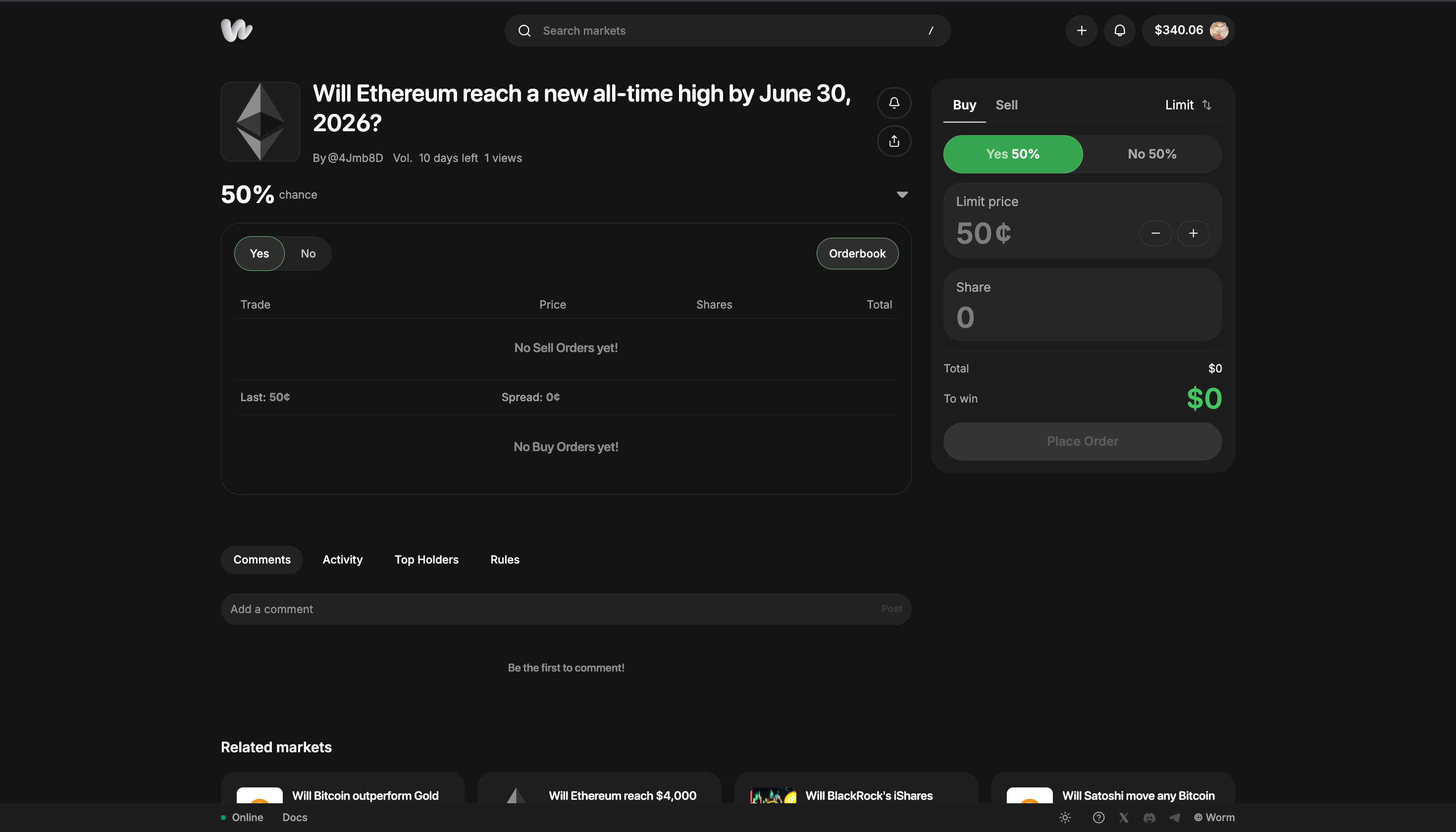
How prices move
Prices change when new trades happen. If many people buy Yes, the Yes price rises. If new information makes the outcome seem less likely, sellers push the price down. Over time, markets with active participants tend to converge toward accurate probabilities.At resolution
When a market resolves, the correct side is worth $1 per share and the incorrect side $0. Traders who held the correct side are paid out automatically on-chain with no manual claim required.Settling & Payouts
Learn about resolution timing, the “under review” state, and how cash-outs work.